‘SHEEPFOLDS’
Sculpted By
Andy Goldsworthy
There are hundreds of sheepfolds in Cumbria, most of them abandoned ruins, built long ago, when farmers did their shepherding on foot and gathered their sheep on, or in the vicinity of the fells. The folds were used to contain the sheep for checking their health, trimming hooves, dressing wounds, treating for parasites and washing, clipping and marking.
Ever since William Wordsworth’s time, ruined sheepfolds have held a special romantic charm for many people, but they also represent an evocative symbolism in a county which is synonymous with sheep farming. Wordsworth described Cumbria as “a perfect republic of shepherds and agriculturalists” and to a certain extent it is still that today.
In 1996 the internationally acclaimed artist Andy Goldsworthy was commissioned by Cumbria County Council to celebrate this “perfect republic of shepherds” with a countywide sculpture project called ‘Sheepfolds’ as part of the UK Year of the Visual Arts.
At its conclusion Andy Goldsworthy and a team of dry stone wallers, led by local expert Steve Allen, completed nearly 50 Sheepfolds, which as a collective whole, is probably the biggest sculpture in the world.
Many of the folds used were derelict and, in some cases, had disappeared altogether and were only located by careful scrutiny of old maps. Concurrent with their restoration Goldsworthy responded creatively to each sheepfold in relation to its context and location. It has a conceptual dimension that is both intimate and expansive. The locations of the individual folds reflect the dramatic scenic variations in the landscape and connect directly to Cumbria’s farming heritage.
‘Sheepfolds’ provides us with a way of engaging with the landscape that challenges our preconceptions of the natural environment and enriches our perception of a cultural landscape that is as much about people as it is about wild nature. The collection subdivides into several distinct groups of folds. Some are one off individual folds or pinfolds and others are in pairs, part of a group, or a distinct series within certain themes. Many of the sheepfolds in the ‘Sheepfolds’ collection are to be found in East Cumbria.
There are Six Pinfold Cairns in the Eden Valley at the following locations:- Bolton, Crosby Ravensworth, Church Brough, Warcop, Outhgill and Raisbeck
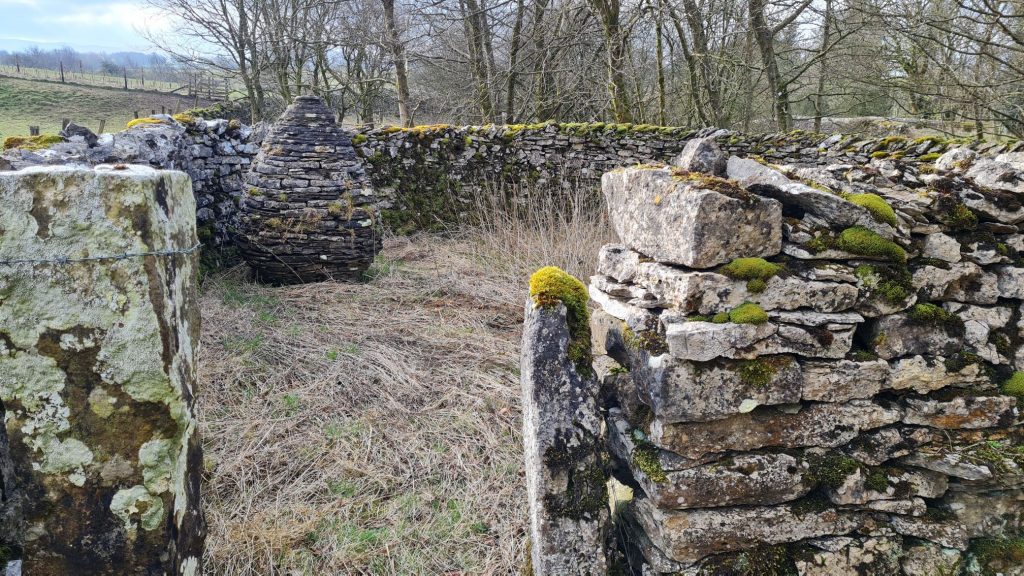
The Nine Standards, on the horizon above Kirkby Stephen, reputedly over 700 years old, were the original inspiration for Goldsworthy’s cone shaped cairns. His cairns have become one of the most repeated and travelled forms in his work – a personal marker on his journeys around the world. Now he has brought the form back to its source, in six village pinfolds near Kirkby Stephen, each cone cairn grown like a stone seed within its protective shell. Pinfolds are sheepfolds which were originally used to pen stray animals that had escaped in the vicinity of a village.
BOLTON is off the A66 between Appleby and Penrith. From the centre of the village take the minor road toward Appleby and the fold is a little way along on the right (NY 638 232).
CROSBY RAVENSWORTH is south of Bolton and east of Shap and the fold is at the south end of the village beside the public footpath to Banks Bridge (NY 621 143).
CHURCH BROUGH is off the A685 just south of Brough. The fold is in the grounds of the Primary School through two gates to the right of the school (NY 794 143).
WARCOP village is signed from the A66 between Appleby and Brough. The fold is on the southern outskirts of the village beside a stream on the B6259 toward Kirkby Stephen (NY 750 154).
OUTHGILL is on the B6259, Kirkby Stephen to Garsdale Head road. Turn off the main road by the telephone box, park by the village green and the fold is tucked into a space just behind the first house further along the track (NY 784 016).
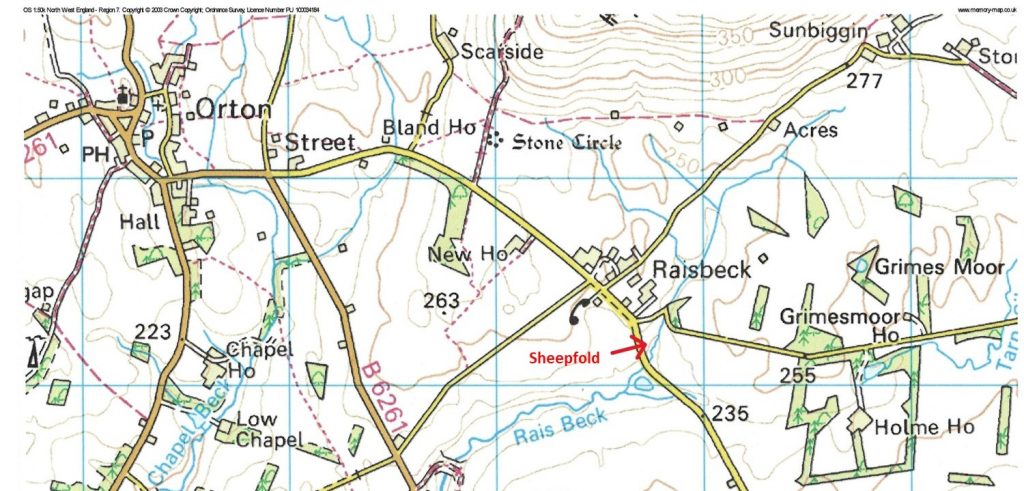
NEAREST to ORTON is
RAISBECK a hamlet on the B6261 east of Orton, near Tebay. The fold is down a slope just outside the hamlet on the road to Kelleth (NY 647 072).